Companies with a robust Environmental, Social and Governance (ESG) Strategy are more successful at attracting and retaining great people and customers.
In addition, they attract higher valuations. Embedding ESG into every day operations helps organisations to mitigate risk, access funds and benefit from commercial opportunities.
Because doing good, is good for business.


If you are going through a funding round or seeking investment, ESG is a critical component. Investors and lenders are increasingly demanding ESG criteria when making funding decisions.
At the same time, a business with good ESG credentials can generate more sales. Any business bidding for public-sector contracts must have a Carbon Reduction Plan and be able to demonstrate how it contributes to the UK target of achieving Net Zero by 2050.
The new UK Procurement Act comes into force on 25 February 2025. It will make it easier for SMEs to access opportunities, bid for contracts, and should also improve payment terms.
The act builds on the UK Social Value Act, mandating that contracting authorities consider social value in tenders and also take steps to minimise environmental impacts.
Businesses that cannot effectively demonstrate their ESG credentials risk losing bids and having contracts not renewed.
A good indicator of ESG’s importance is the growing number of laws in this area. You might think that new requirements such as the EU Corporate Sustainability Reporting Directive (CSRD) impact only large international corporates, but the reality is that those corporates will demand ESG data from the businesses in their supply chain, who will demand the same data from their own suppliers, and so on.
Everyone in the commercial ecosystem must demonstrate their work on carbon reduction, fair pay, social impact, or other ESG priorities – they need to evidence that they are ethical and responsible.
A further example is the UK Green Claims Code, which sets out the government guidance for all businesses making environmental claims. It aims to protect the rights of the consumer. Fines can be imposed on individual businesses that fail to meet the guidance and are deemed to be “greenwashing”.
Perhaps the most important reason to embed ESG in the organisation is – quite simply – that it’s the right thing to do. Evidence also shows that consumers are attracted to “purposeful” brands – this is one reason for the rise of the B Corp movement.
In turn, employees want to work for a business that takes its responsibility to People and Planet seriously. They want to feel part of a Business for Good. Increasingly, both potential employees and customers want to align themselves with businesses that have ESG in their DNA.



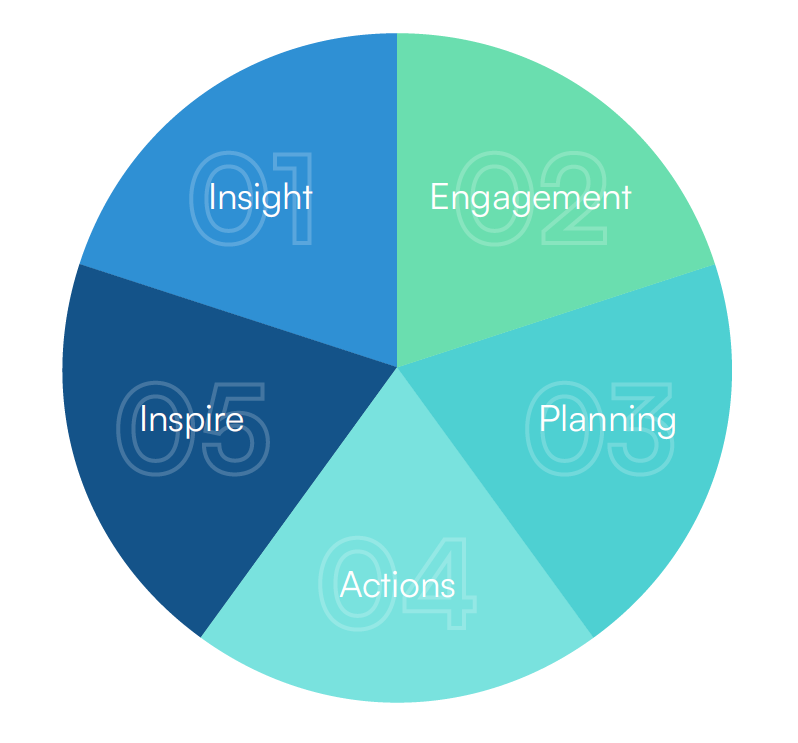
What matters most to your organisation? We research societal trends, review risk, benchmark competitors, and complete a materiality analysis – gathering insights helps to build the Fact Base for an effective strategy.
Engaging with Operational Leads to pilot ideas, and presenting to the Executive Team so they champion the strategy. From grass-roots to C-Suite, from employees to investors – we map and address stakeholder
needs.
Our implementation plans are practical, robust, and within the organisation’s capabilities. Setting measurable targets and timelines ensures that innovative ideas can be delivered effectively.
Embedding programmes and services, onboarding new partnerships, and training employees are crucial steps. Taking actions that matter to customers, colleagues and the community.
Monitoring outcomes and measuring impact builds a toolkit for marketing and communications, events, volunteering programmes, and reporting. We showcase and celebrate your achievements to build brand love.

General Enquiries
+44 (0) 333 123 7171
The registered office of BHP Professional Services Limited (registered under number 16581958 in England and Wales) is Albert Works, Sidney Street, Sheffield, S1 4RG